
What it is
Overview
A visual workflow builder for creating AI agents and automated processes without writing code. Dify lets users drag and drop building blocks to construct agentic workflows, then deploy them as web apps, APIs, or chatbots. The tool draws AI developers, workflow automation specialists, and technical product managers who want to prototype agent behaviors quickly. Early reviewers praise the visual interface and multiple deployment options, though the 10-review sample is too small to verify broader patterns.
At a glance
Usability & Quality overview
Best for
- visual AI workflow orchestration
- RAG and chatbot apps
- LLM-agnostic agent backends
Watch out for
- steep learning curve
- advanced workflow gaps
- support responsiveness
Built on another provider's modelResells a third-party model API
Dify offers a complete workflow orchestration platform that goes well beyond simple ChatGPT wrappers. It provides visual workflow building, multi-step automation, deployment APIs, and specialized developer integrations that create a fundamentally different experience than typing prompts into ChatGPT directly.
Strong evidenceQuality score
Dify is a visual AI app and agent builder for workflows, RAG, and chatbot backends.
This score is our editorial judgment, computed automatically from the sources, weights, and dates shown above. It reflects the data we could verify as of July 28, 2026, not a guarantee or statement of fact about Dify. Third-party ratings and quotes belong to their original platforms and authors. Thin data lowers our confidence label, and we say so instead of guessing. Work on Dify? Dispute any datapoint and we will review it, publish your response, and correct verified errors.
Plans
Pricing
How free is free?
Genuinely free
Open-source self-hosting + cloud sandbox; no time limits
What you get for free
- Sandbox environment for trying core features
- Full open-source self-hosting with Docker
- Apache-2.0-derivative license for non-commercial use
- Visual drag-and-drop AI agent builder
Behind the paywall
- Commercial use and enterprise featuresProfessional
- Team collaboration toolsTeam
- Higher throughput limitsTeam
Community feedback
Aggregated reviews
Ratings and quoted comments below are aggregated from third-party sources and reflect those users' views, not SearchTools.ai's.
What reviewers talk about
themes inside the Sentiment pillar — not score ingredients
60Output Quality18 mentions
“been running agent workflows for our team and like most people we started with the obvious choices. Dify for the prototyping power, Langflow for the canvas. both hit walls when we tried to actually ship to production. Dify is great until you try to customize the underlying python or embed it in an existing system. it's built as a self-contained SaaS-style platform, so deep modifications fight you the whole way. Langflow has the cleanest visual canvas of anything I've tried, but production-grade ”
“I'm experimenting it myself for quite a while and as a developer well versed in devops I think the project is awful. I think that the number of GitHub stars come from the no-developer people. The company I'm in used to work with Node Red, another low-code automation tool, and when the workflow started to grow there was a sudden stop in developing and a huge spike in troubleshooting. I think Dify is just a cool toy for people who don't know how to code. I get that I'm angry since some basic funct”
“Hey Redditors, A classic case of analysis paralysis here, and I need your help. I've been deep-diving into platforms for building Agents, and after a fierce battle royale, I'm down to the final two: n8n and Dify. Now I'm completely stuck and don't know who to pick. Dify: The "Star Student" of AI-Native Apps My first impression of this thing is that it's a complete package. Knowledge base management (RAG), prompt engineering, and a ton of out-of-the-box plugins and templates—it feels like it was ”
“The idea is promising: a no-code platform for orchestrating LLM workflows, with integrations, HTTP requests, and conditional logic. The UI is clean and intuitive. Deployment options like API access and web app generation are convenient, and the self-hosted version gives good flexibility for internal use cases. - There’s no way to pass hidden input variables to workflows at chat start — they’re always visible to the user, which breaks many personalization or routing use cases. - Variable size lim”
42Reliabilitythin data · 8 mentions
“bro,i have the same feeling about it. im software engineer for 10 years. when use dify,i was stucked on every step. My point is it provide a well designed environment.and if you don't know how to deploy to the server.the dify cloud is the best to use.”
“I am looking to deploy Dify on my local server correctely for try to use it as producction service. my server is made in proxmox (services and vm virtual machines) and my dify is running ina vm with ubuntu 22.04 with the minimun especs: 2cores, 4gb ram Could you provide me an advise or a detailed guide or best practices to modify the .env file for correctly deploying Dify on local server for production? any help could be a great thanks”
“the shortlist flattens two product categories that fail differently in production. server-side workflow builders (n8n, dify, copilot studio) are stateless between runs and the failure mode is integration drift when a downstream api shifts a field. desktop-resident agents are stateful, hold cross-app session context, and the failure mode is the host os sandboxing them out of the apps they're supposed to act inside. 'execution and orchestration decide whether ai ships' is true, but the orchestrati”
“Elasticsearchに動画の通り変えてみたところ「Elasticsearchクライアントの初期化に失敗しました。Elasticsearchへの接続に失敗しました。」というエラーが出ます。.env以外に設定する箇所はありますか?”
49Ease of Use26 mentions
“What's your background? If you can code or have access to devs, I'd look into something that's code-based like PydanticAI, smolagents, CrewAI or LangGraph. But Dify, along with Flowise provide viable low/no code alternatives to building agents in code. One of the benefits of Dify is the abundance of prebuilt templates and tools, whereas in code you'll have to write everything from scratch - or borrow from GitHub. But the flip side is once the app becomes successful and you get paying customers, ”
“I'm experimenting it myself for quite a while and as a developer well versed in devops I think the project is awful. I think that the number of GitHub stars come from the no-developer people. The company I'm in used to work with Node Red, another low-code automation tool, and when the workflow started to grow there was a sudden stop in developing and a huge spike in troubleshooting. I think Dify is just a cool toy for people who don't know how to code. I get that I'm angry since some basic funct”
“been running agent workflows for our team and like most people we started with the obvious choices. Dify for the prototyping power, Langflow for the canvas. both hit walls when we tried to actually ship to production. Dify is great until you try to customize the underlying python or embed it in an existing system. it's built as a self-contained SaaS-style platform, so deep modifications fight you the whole way. Langflow has the cleanest visual canvas of anything I've tried, but production-grade ”
“I'm trying to build an AI agent in Dify but running into issues at pretty much every step. The learning curve is steeper than I expected even though I have developer experience. My goal is to create a price catalogue extractor that ingests data and returns matching items through an API. If I can get this working, I'd want to use it for other projects at our small company. I think once I understand the logic and have some templates ready, development speed would improve a lot. Right now I'm stuck”
Watch & learn
Video content
YouTube YOUTUBE90 views
This AI App Builder CRUSHES n8n (Dify)
Traits-DIa3 months ago
 YOUTUBE42 views
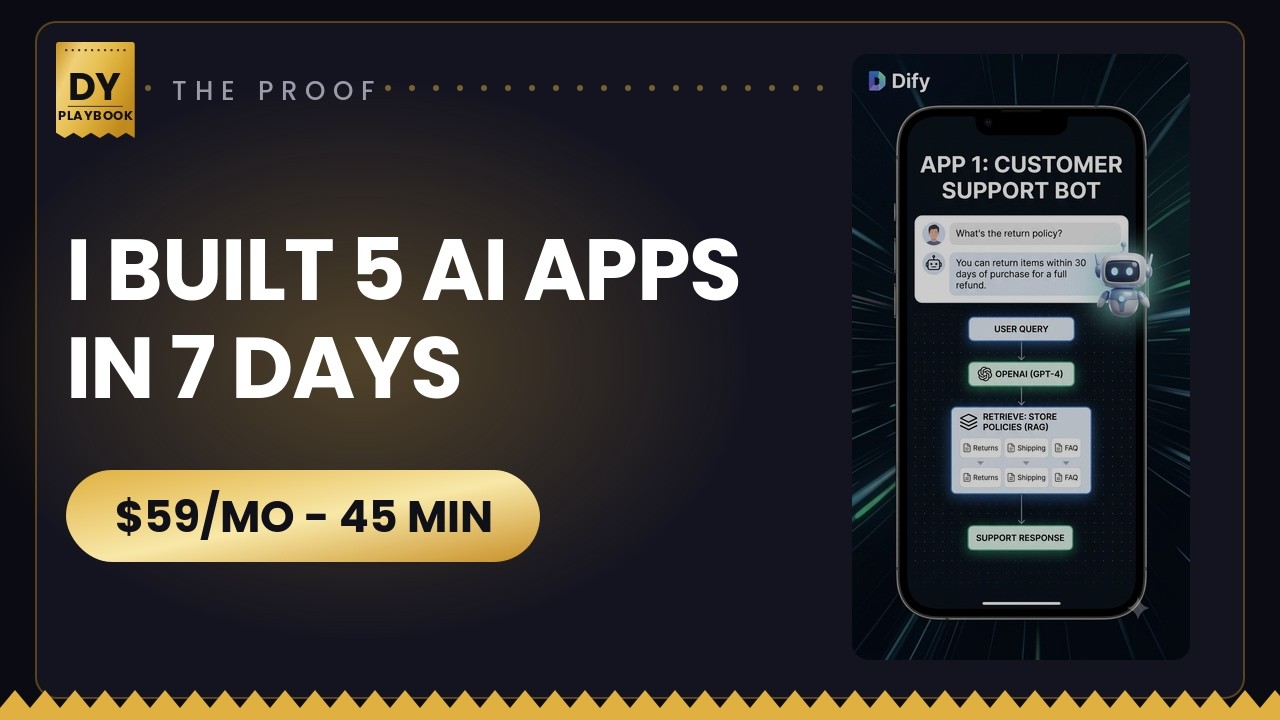
I Built 5 AI Apps in 7 Days With Dify (Is LangChain Dead?)
DYPlaybook2 months ago
 YOUTUBE32 views
Coze vs Dify Which AI App Builder Is Better
twiz272 months ago
 YOUTUBE20 views
Flowise vs Langflow vs Dify vs VectorShift vs Voiceflow — 2026 AI Platform Competition
YourTechGuruOfficial2 months ago
Capabilities
Key features
Agent Builder
Builds autonomous AI agents that plan and execute multi-step tasks for you
Workflow Management
Automates multi-step processes and routes tasks across your tools and team
Chatbot Builder
Creates custom chatbots for your site or business without writing code
App Builder
Builds working applications from plain-language descriptions without manual coding
The honest take
What users love & flag
Distinct themes surfaced across 27 reviews from 2 sources — each grounded in real review text, ranked by how often it comes up.
Questions
Frequently asked
What is Dify?
Dify is a platform for building production-ready AI agents and workflows using visual drag-and-drop tools. It enables both technical and non-technical users to create sophisticated AI applications without extensive coding, and supports deployment on cloud, VPC, or self-hosted infrastructure with enterprise-grade security.
Is Dify free to use?
Yes, Dify offers free options including a Sandbox tier with 200 message credits and basic features for testing, plus a Community edition for open-source enthusiasts and non-commercial projects. Paid Professional and Team plans are available annually for production use with higher limits and additional features.
How does Dify's visual workflow builder work?
Dify's Workflow Studio uses a visual canvas where you connect building blocks through drag-and-drop to create AI applications. You define how applications think, retrieve data, make decisions, use tools, and complete tasks by connecting nodes on the visual interface, without needing to write code.
What deployment options does Dify support?
Dify offers flexible deployment across cloud infrastructure, private VPCs, or self-hosted environments using Docker. This allows teams to choose their preferred hosting approach rather than being locked into a specific platform, with the same visual development experience across all deployment models.
Can Dify process and use my existing documents and data?
Yes, Dify includes a Knowledge Pipeline feature that processes files, websites, and online documents by extracting, cleaning, chunking, and indexing the content. This processed knowledge can then be connected to your AI agents or workflows for retrieval-augmented generation (RAG) applications.
What types of applications can I build and deploy with Dify?
You can create AI agents with configurable tools and memory, plus complex workflows that combine multiple AI capabilities. These can be deployed as web applications, API endpoints, embedded tools, or MCP-compatible tools, with built-in monitoring and feedback collection.
Does Dify provide pre-built integrations and components?
Yes, Dify includes a Marketplace with pre-built integrations for model providers, tools, and data sources that teams can reuse across projects. This helps accelerate development by providing ready-made components rather than building everything from scratch.
What's included in Dify's paid plans?
The Professional plan includes 5,000 monthly message credits, 3 team members, 50 apps, 500 knowledge documents, and priority processing. The Team plan supports 50 members, 10,000 message credits, 200 apps, and enhanced processing capabilities, while Enterprise offers custom pricing with SSO and advanced security controls.
Compare Dify
Compare with another toolMore Like This
