
What it is
Overview
A code analysis tool that builds persistent graphs from your codebase to compress context for AI code review sessions. Code-review-graph generates Abstract Syntax Tree representations of your files and maintains them automatically through file watchers. The tool targets developers using Claude, Cursor, or Copilot who hit context window limits when asking AI to review large codebases. Built as a non-AI utility that feeds structured data to existing AI clients.
At a glance
Usability & Quality overview
Best for
- AI-assisted code review
- large-repo context reduction
- local-first developer workflows
Watch out for
- Real-world user feedback is sparse in public discussions.
- Effectiveness is easier to verify than satisfaction from this evidence set.
Real product, not a wrapperIndependent product
Creates persistent code graphs using AST parsing that other tools don't provide, with automated file watching and MCP server integration. Solves the specific problem of AI context window limitations with a novel technical approach.
Strong evidenceQuality score
code-review-graph Local-first code intelligence for AI code review and context reduction.
This score is our editorial judgment, computed automatically from the sources, weights, and dates shown above. It reflects the data we could verify as of August 7, 2026, not a guarantee or statement of fact about code-review-graph. Third-party ratings and quotes belong to their original platforms and authors. Thin data lowers our confidence label, and we say so instead of guessing. Work on code-review-graph? Dispute any datapoint and we will review it, publish your response, and correct verified errors.
PricingFree
Individual plan details haven't been verified yet — they'll appear here on the next data refresh.
Community feedback
Aggregated reviews
Ratings and quoted comments below are aggregated from third-party sources and reflect those users' views, not SearchTools.ai's.
What reviewers talk about
themes inside the Sentiment pillar — not score ingredients
34Output Quality10 mentions
“This is the closest I have seen to what I am doing with my own graphing solution. I dig it. AST is seldom mentioned here, nice to see it getting some love. Thankfully I have already incorporated a solution like this, but your approach feels solid at a high level. The rest of the components in here can be handled many different ways so it’s fairly subjective, but the graphing element is what makes this viable for anyone working on a larger codebase. Having that level of visibility into what you a”
“Scroll to bottom for tldr In July, JetBrains reran the headline claims of two token-saving tools on real agent workloads. Caveman claimed 65% and measured 8.5%.RTK claimed 60–90% and ended up slightly more expensive than using nothing. Greptile’s reported 82% reduction also became 45% when Augment reran it. It looked like a pattern of over claiming numbers, so I benchmarked five codebase tools under conditions closer to how agents actually use them. my setup was : 15 Django questions drawn from ”
“the fact that two tools were statistically identical to grep is basically all anyone needs to know about the current state of this also appreciate you calling out the prompt caching quirk, i've seen so many benchmarks where the running order accidentally makes the last tool look like a miracle worker curious if you tried any of these with a cold cache on every run or if that's just not practical with 90 runs per harness”
“the adoption instability is a bigger finding than youve given it room for. repowise going 15/15 then 4/15 then 3/15 across reruns means your claude code headline is a saving conditional on being called, and what a user gets is that number times the probability it gets called at all. those sit as two separate quantities in your tables and the product is what people actually experience. something that saves 16% when used and gets used a fifth of the time saves about 3%. report the product with its”
Watch & learn
Video content
YouTube YOUTUBE5.6K views
Your agent burns 20k tokens just to get oriented (Code Review Graph skill solves this)
MatheusBattisti2 months ago
 YOUTUBE1.5K views
Your AI Reads 25,000 Tokens to Review 3 Functions. This Free Tool Reads 700 (code-review-graph)
hyperautomationlabs10452 months ago
 YOUTUBE767 views
Stop Burning Tokens: code-review-graph Cuts AI Review Costs by 82X
full_stackYT2 months ago
 YOUTUBE318 views
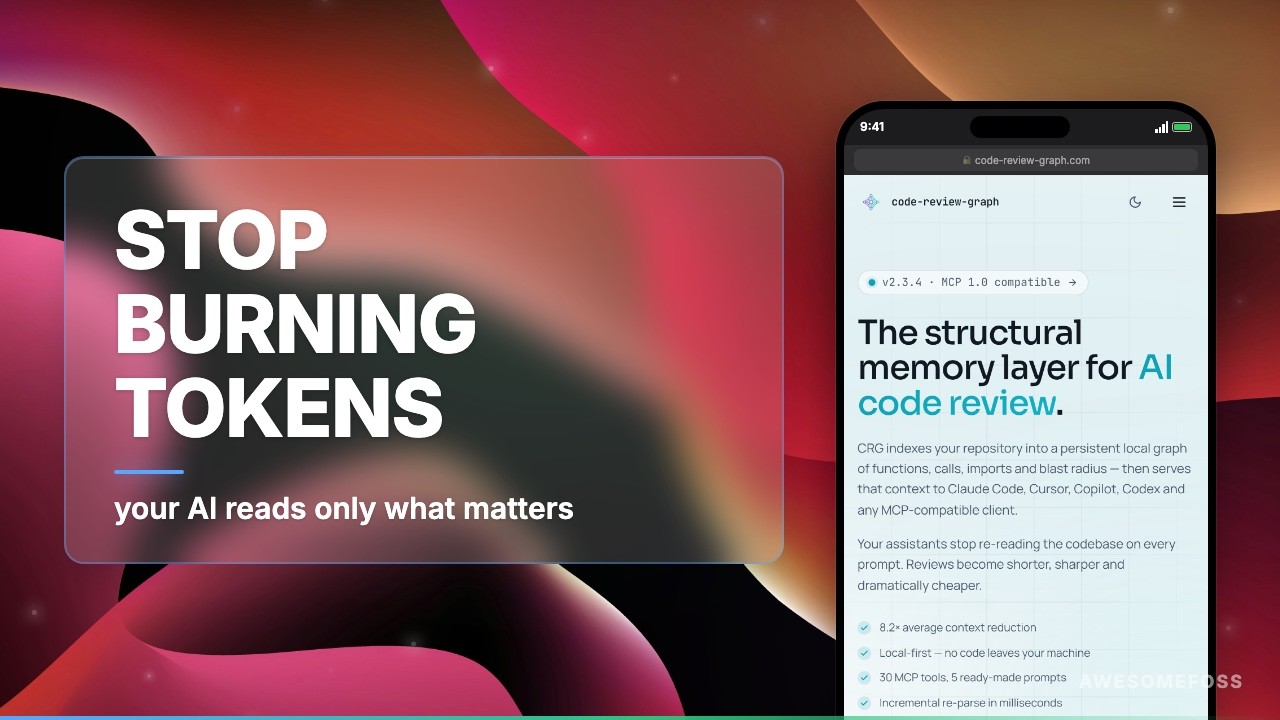
code-review-graph: 82x Less Context for AI Code Review
AwesomeFOSS2 months ago
 YOUTUBE242 views
I Ran A 20K-Star AI Tool. It Flagged A Fifth Of My Repo
mishkaAI2 months ago
 YOUTUBE284 views
Code Review Graph Github: Slash 80x AI Tokens Cost
RayCodingCorner2 months ago
Capabilities
Key features
Developer Tools
Provides utilities that help programmers build, test, and ship software faster
The honest take
What users love & flag
Distinct themes surfaced across user reviews — each grounded in real review text, ranked by how often it comes up.
Questions
Frequently asked
What is code-review-graph?
Code-review-graph is an open-source tool that creates persistent local code graphs to make AI-assisted code reviews more efficient. It reduces the context that AI assistants like Claude, Cursor, and Copilot need to process by an average of 8.2x, addressing the problem where AI tools repeatedly re-read entire repositories for every review request.
How much does code-review-graph reduce AI context consumption?
According to benchmarks across 6 open-source repositories and 13 commits, code-review-graph achieves an average 8.2x reduction in tokens per review. For larger codebases, the reduction can be as significant as 49x fewer tokens, making AI reviews much more cost-effective and faster.
Which AI coding assistants work with code-review-graph?
Code-review-graph integrates with major AI coding platforms including Claude Code, Cursor, Copilot, Codex, Windsurf, Zed, and Gemini. It connects through both the Model Context Protocol (MCP) and command-line interface to serve these AI clients with optimized context.
How fast does code-review-graph update when code changes?
The tool performs incremental re-parsing in under 200 milliseconds when code changes occur. Instead of rebuilding the entire graph, it updates only the affected portions, making it highly responsive to ongoing development work.
Does my code data stay private with code-review-graph?
Yes, code-review-graph uses a local-first architecture where your code never leaves your machine. The tool creates a SQLite-backed graph database stored locally and operates entirely on your own system, ensuring complete privacy and security of your codebase.
What programming languages does code-review-graph support?
Code-review-graph processes 56 file extensions using Tree-sitter to parse source files, functions, classes, imports, and call chains. While the specific languages aren't listed, Tree-sitter supports most major programming languages used in software development.
How do I install and start using code-review-graph?
Installation is straightforward with a simple pip install command. Once installed, the system builds persistent graphs that can serve multiple AI clients simultaneously from a single local database, and it provides 30 MCP tools and 5 ready-made prompts for immediate use.
What is blast radius analysis in code-review-graph?
Blast radius analysis is a feature that computes which code sections are actually affected by specific changes. Combined with community clusters and risk scores, it helps determine what areas require review attention, allowing the tool to send only relevant call chains and risk areas to AI models instead of entire repositories.
Compare code-review-graph
Compare with another toolMore Like This
